Sky Studio Designs
Table of Contents
Sky News
Technology Innovation
Richard introduced LED lighting in stages across all their studios, initially for energy-efficiency and reliability reasons. Later this change was a fundamental component that enabled the introduction of Remote Operations into all of these spaces; something that simply wouldn’t have been possible with traditional tungsten luminaries. The most critical reasons being Fire & Electrical Safety. But no longer having to randomly change bulbs at short notice was operationally key as well
Between 2013 and 2020, as the entire variety of studio and newsroom spaces were either built from scratch or refurbished, he ensured that each was equipped with the best and most suitable LED luminaries available at the time, including:
- ETC Source 4 Series 1 Studio initially then Series 2 Daylight
- Arri SkyPanel S30RP & S60RP. L-series L7-DT
- Litepanels Gemini 2x1 & 1x1, Astra 3X & 6X, Sola 4+
- Dedolight DL-9
- ChromaQ Spaceforce
Quantities used for main fixed studios
| S4-II-D | L7-DT | S60-RP | S30-RP | SF | |
|---|---|---|---|---|---|
| 21 Glass Box | 15x | 11x | 14x | 19x | 0x |
| 6 Real & VR | 13x | 7x | 32x | 9x | 6x |
| DL-9 | Astra 3X | Astra 6x | Sola 4+ | |
|---|---|---|---|---|
| Millbank Main | 20x | 12x | 12x | 10x |
Project Tardis - Introduction
A whole series of changes for Sky News came under the umbrella of Project Tardis and its follow-on the City Studios. This mammoth project was to move Sky News out of their own building (Unit 1) across the road to Sky Studios, and in the process introduce cost savings by automating the Production workflow.
This was originally expected to take 6 months, but actually took 18 months. The overall total number of production staff reduced was a tiny handful - for example, the Director’s Assistant and Vision Mixer roles went, but were replaced by Co-Producers …and a lot of faith in the Space Bar.
Despite original optimistic promises, both Cameras and Sound ended-up much the same as before (Remotely operated with FM assistance, apart from a Jib), but sadly the Lighting Technical Operators did disappear, with their work taken on by the Technical Supervisors (previously called Technical Directors thanks to an earlier cost-cutting exercise).
Like all massive and complex projects the reasons were many, however no doubt if it had been framed as an 18 month project with no job losses, it would have taken 3 years and resulted in increased staffing…
Due to the unpredictable impact and costs of Wars, Elections, and other disasters (…), any attempt at fixed budgets and timelines, let alone predictable work and utilisation patterns, are of little meaning to a News organisation.
To fit Sky News into Sky Studios took substantial internal rebuilding efforts throughout to make enough space with a completely remodelled second floor, just 5 years after the building opened - everything from dressing rooms to edit suits had to be moved-about (something that became a recurring theme over the next few years, as ever-more technical things were squeezed to fit into a building that was compressed from its original intentions during Construction.) Hence the “Tardis” name - nothing to do with a rival broadcaster, everything to do with making lots of big things fit into a impossibly small space although with less space-time distortion…well, apart from the dark mysterious bit at the back of the 4th floor with the indecipherable technical equipment and mysterious gnomic people… oh wait, that’s Engineering Support.
Anyway, getting all the various aspects of this built and on-air tied-up Richard for a minimum of 2 days a week for 18 months, working on partial attachment to the loverly Projects Department. And then someone forgot to cross-bill all that time! Whilst the lighting side he developed solo, he also was part of the technical evaluation teams for various related aspects, gaining valuable experience in not just the formal bid processes for multi-million pound contracts, but the disconnect between promises and deliverables.
Project Tardis - Studio 21 (2016) “The Glass Box” Flagship
This is, as the nickname suggests, a studio in a large Glass Box in the middle the huge Sky Central office building The size of a 33-story tower block, but lying on its side. This was intended by the architects as a showcase general-purpose studio, located in a prominent position to been seen in-use by all visitors and staff in the building - instead of hidden-away and mysterious like most studios. This was an important move to make for a company that, which despite its roots being in broadcasting, was rapidly transforming into a huge Telecommunications & IT organisation At its peak, Broadcasting technicians made-uup a tiny 700 out of 30,000+ people, although sadly both figures have been reduced drastically since then.
However, during Construction, the various broadcasting areas (Sports, Entertainments, etc.) were consulted and shown the space, but only Sky News expressed an interest in actually using this studio. This meant that, instead of the studio being a manned, multi-purpose, area with (somehow…) lots of set / camera / lighting changes, it would now be possible to build a static studio set with a fixed technical infrastructure and minimal on-site staffing.
This was a concept that Sky News had started moving-towards with their Millbank Studio in 2010-11, which was then taken one step further by having just a Floor Manager (assisted by Make-Up and a Runner at busy times) and everything else being controlled from another building 10 minutes walk away.
At Millbank, as originally built, between 2x and 4x technical staff covered the studio locally, with the rest of the production process usually being done remotely. A full-size gallery was built, with the intention of being able to stand-alone as Disaster Recovery, should the main site ever go catastrophically offline - but this never had sufficient resources to stand alone, and with no Generator backup (unlike Osterley) it would have had trouble standing-up to a catastrophic failure at Osterley for any length of time, so the DR plans bypassed Millbank unless it was on-air at the time.
The core team was a Technical Director - doing everything Technical from routing video feeds to the lighting - paired with all the studio floor work being done by the Floor Manager (mostly ushering guests in and out, including acting as Sound Assistant, i.e. putting microphones on). Yes, the clue was there all along in the job titles…
The cameras could be repositioned by these two into pre-marked positions, and then remotely-operated pan/tilt heads allowed for pre-set shots to be quickly recalled by the TD at quieter times. For busier productions, primarily around the evening politics show, and also for pre-recorded shows such as Entertainment Weekly, crewing numbers doubled with the addition of a Sound Supervisor and a Camera Operator - although still controlling the heads remotely. The gallery also made up the background of one of the main shots through a large viewing window (matching the then-main studio design) …and any visiting Lighting Director would quickly discover that the seat they were in was empty for reason…the back of their head was now very prominently silhouetted on live TV around the world, just behind the presenter’s ear…
For the glass box, as the Tardis project had begone, News decided to take this one step further, and have just a Floor Manager in the actual studios, and have all the technical control done remotely from the Gallery. Due to delays in Tardis, this remote control was temporarily re-routed to the old PCR (Production Control Room, or “Gallery”) for the first year after the building amd studio opened.
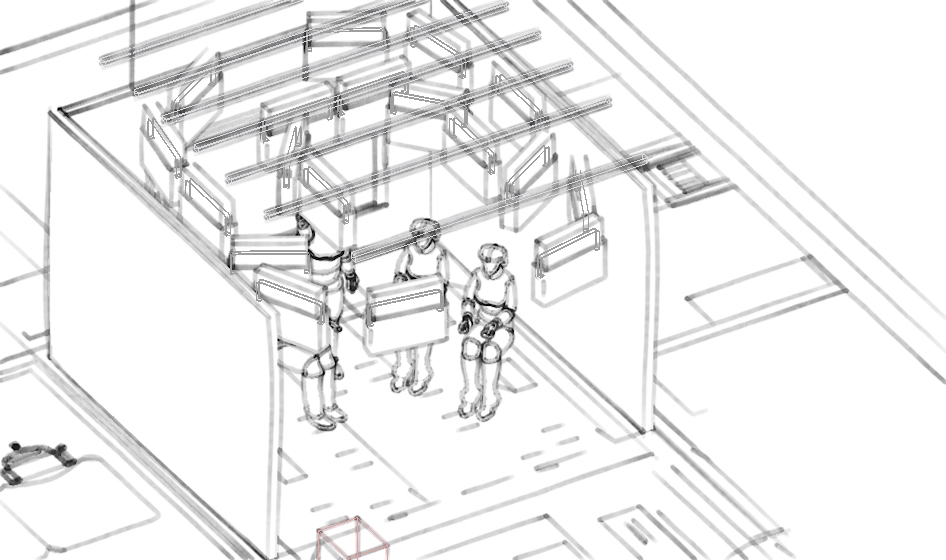
That’s the operation… but why the strange hanging cameras? This was the result of the collision between the desire by News for a simple, static space with freedom to use the whole area, together with an edict from the then-CEO of Sky UK, Jeremy Darroch, that the view from the outside should be completely clear of ALL technical equipment, cables, etc on the floor - which including the cameras! Never mind what the viewers at home see, the viewers outside the studio are more important… He did have a point though about the TV Production on-site being invisible to most staff…_ Ok, fair enough, we’ll hang the cameras down on fixed bars in the corners, we can get them just about far enough away, and can have the lights as far back as possible without one obstructing the other.
But…News insists that the cameras have to be repositionable live in-vision, because of course they (and the architects) had been expecting robotic peds, similar to their existing main Studio A. Unlike floor cameras that can freely move about in 6-axis, hanging cameras can’t without some kind of X-Y axis or robotic arm system that there just wasn’t space for, as well as as making it impossible to hang anything else …such as lights. Taking the concept of film dollies on tracks, two neat slightly-curved arcs were designed running up and down the studio front to back, together with a straight central track. Unfortunately, after these camera tracks were designed and ordering, News had a wobbly moment and decide to spin the majority of their presentation positions though 90-degrees..and now the cameras are tracking on the wrong axis. Doh! Anyway, back to lighting : Physics (or Optics) has, as a result of these moving and hanging cameras, moved from being “its a bit tight, and there’s a lot of Daylight” to “oh…that’s a really big problem!”. Up to this stage, the Sky News Lighting Style was very much a traditional TV-style, with clean hard keys and tightly-set Fills / Kicks / Backlights, each set lighting a single person.. But either the cameras / arms would end-up constantly moving in front of these hard lights, causing random flashes and blackouts…or the angles would have to be horrendously steep (60+ degrees), giving very unflattering faces even if balanced with uplighters…!
Jon Bennett decided to bring in Dave Evans as a Freelance Consultant LD with his extensive design experience of News Studios. His solution to the lighting dilemma was both elegant and effective, and eventually determined the lighting style desired by Sky News for the rest of the decade, with its wide flexibility about where guests could go and still be seen, with only minimal adjustments needed for different skin tones etc.
The lights were a dense 360-degree ring of Arri S60 Softlights, all with very narrow eggcrates in order to minimise unwanted spill behind and flares on camera… which also removed about 70% of their light output… This was then augmented by various clusters of ETC Source-4-II LED profiles which gave a sparkle in people’s eyes and helped add more 3-dimensionality to a flattened softlit person. However, these S4 were definitely not the main source of light on people’s faces, due to being run at very low level so that, should a camera be in front blocking it, it would not be catastrophic to the light levels on their face, and would not lead to random annoying camera shadows as they are repositioning. Which was just as well, as the ideal place to put a keylight for a presenter reading Autocue directly to camera… is normally right above the camera, except that means there’s now a large metal descender bar right in font of the lights. Not an issue for the softlights, but fatal for a Profile or a small Fresnel…
Nothing to show in [https://www.lightingdir.com/ images/SkyBuilds/GlassBox ] or folder does not existProject Tardis - Studio 6 (2017) - Real and Virtual Reality spaces
This was originally designed to fit on an unused area of the 2nd floor (above the coffee shop and next to the proposed new Newsroom area)…until it was realised that section of the building was cantilevered over thin air, and would need substantial reinforcement to take the weight of the video walls. Oops. So it was then hurriedly transposed to Studio 6 - evicting Soccer Saturday to a smaller studio mid-season, which was a complex challenge to seamlessly achieve within in a week in its own right. And…then it was found that the cameras moved with the production, there was no budget left for Sony 4300 as per the Glass Box, resulting in a bodge to first source and then install LDK-8000 cameras into the galleries, which then in turn messed-up the intended lighting control position… And that’s the vastly simplified story….
In all big and interconnected projects, nothing pans-out entirely as intended!
Nothing to show in [https://www.lightingdir.com/ images/SkyBuilds/Studio6 ] or folder does not existProject Tardis - Studio 22 - Self-Op & Shared use (2017)
TBA
Project Tardis - New Control System with Remote Operations (2017-2023)
A major part of this 18 month project as well as moving the entire Newsroom and building a new Studio, was creating two new dedicated Production Control Rooms from scratch. As part of the push towards studio automation, it had already been decided at the highest level (without consulting any lighting specialists) that lighting was so simple that its operators could be replaced by automation and improved technology, plus in America (where the Automation companies were based) the Technical Director did the lighting as well as racking the cameras. This decision had been made after looking at the american local cable-tv market, which was very much locked-off shots and ultra-flat soft lighting - rather than unpredictable moving shots with even more unpredictable subjects in vision, lit with variations on 3-point lighting. This concept was sold as also being applicable to cameras and sound… except they managed to swerve the axe
From the experience with the diffused daylight-enhanced Glass Box which had just been opened, and the praise for the generally brighter and overall softer look given compared to the traditional multi-point lighting Multipoint because some positions had 3-points, others could have up to 6 with the flexibility it gave Producers of having more guests on set than it was built for (e.g. groups standing, dogs wandering about, etc) without being constrained by very fixed pre-lit positions.
To fill this brief, a unique and unprecedented control system had to be developed. This was done entirely by Richard, and, once on-air, this system ran 24/7 for 7 years as further studio spaces were developed and updates applied in short breaks
- Live simultaneous control of 7 studios across 4 sites on 2 continents.
- Making this quite probably the largest continuously-operating ETC Eos Network in world by geography.
- Two main PCRs with ETC Eos series consoles running synchronised (Main + Backup)
- Three local PCRs with consoles running the same software, but only local sessions, to avoid any network issues such as Latency/Bandwidth/Disconnections
- Hardware VPNs were used to encapsulate and route the …highly Corporate IT unfriendly… sACN lighting traffic through Broadcast networks without complications.
- all communications between Local and Central consoles was simply to hand or take control back and forth
- This was achieved by Smoke Signals (see below).
- This system was then extended to interconnect with different broadcasters (SSN and CNBC) so that certain studio spaces could be shared, despite totally different control systems and without needing any manual interventions such as repatching.
- Hardware VPN used to encapsulate and route traffic across internal networks with no Corporate IT complications.
- largest ETC Eos Network in world (by geography)
- Conditional and Sequential controls whilst being entirely macro and magic-sheet driven
- Designed, Developed and entirely Programmed by RB
Tardis II - the Rise of the Tardis
This wasn’t really called Tardis II, but that’s what the revised control system got called.
The success of the Millbank remote studios resulted in a push to do the same with other remote studios. A minor Down-The-Line setup in Washington, DC, USA, extended the reach of the lighting network across the Atlantic, making this probably the largest (by distance) lighting network in continuous real-time use. Latency was surprisingly low, although the local control was used most of the time. And then there was the relocation of the City Studio out of the Gerkin.
This prompted a significant re-thinking of the control system - out went the original concept of the two gallery consoles each having effectively two users - which saved a huge amount of duplicated work, thankfully - along with the manual hand-over between the Osterley and Millbank TS, and in came a universal automatic system of sharing of control between Osterley and any Local consoles. This was done via an ingenious system of “DMX smoke signals” - basically, one sACN universe was dedicated to each studio, with one set of channels being patched + used by Osterley, and another set of channels by the “local” console, etc. Further channels would indicate Blackout and so forth. This was a completely automated sequence of triggers, and was even integrated the famous “Default Values” as taking control of the studio was implicit. .which eliminated any human-error (or hunan simply not being anywhere near their console!) problems of the old system, as either end could force control to themselves, or even push it to the other end. Changes to these would automatically trigger submaster changes t001 being Osterley, expansion to include both “Locking” controls, “Lock Overrides”, and “Crash Change” were designed but in practice were found not to be needed and would just add unnecessary complexity for edge case scenarios such as a TS being suddenly taken ill mid-show.
This exchange of control extended downstairs to Sky Sports News, so that a section their studio used by Sky News could be controlled by either of them, without actually connecting their networks except via 2-way DMX “Firewall”.
But that wasn’t all. for the two studios at CNBC, control had to be given **or taken** not just by a local SKy console (ETC Nomad PC with Touchscreen) but by CNBC, with their own entirely different lighting control system. In the middle of the night, and without relying on any human intervention such as repatching. sACN merging of different networks was way too risky, however, dropping down again to DMX, XTBA had the solution with their Smart Switch 2:1 - combining this with the Sky dual-source system meant each studio had triple control sources - and this worked flawlessly all the time the Tardis II system was operational.
flowchart LR
    OstA([Osterley PCR-21])
    OstB([Osterley PCR-22])
    Ost[Mikrotik Router]

    M([Millbank PCR])
    N[Millbank Node]
    S(((Millbank Studio)))
    NR(((Newsroom)))
    ENG(((ENG)))

    FW1[Sky News Firewall In / Out]
    FW2[Sky Sports News Firewall In / Out]
    SS(((SNAP Position)))
    SSNHQ([Sky Sports News Floor MSO])
    SSNHQ2([Sky Sports News PCR TS])

    C[City Node]
    CP([City Sky PCR])
    CP2([CNBC PCR])
    CX2["XTBA 2-1 Priority Sky"]
    CX3["XTBA 2-1 Priority CNBC"]
    CS2(((City Studio 2)))
    CS3(((City Studio 3)))

    W[Washington Node]
    WS(((Washington DTL)))
    WP([Washington Local Faders])

    ST6[Studio 6 Node]
    ST6S(((Studio 6)))
    ST21[Studio 21 Node]
    ST21S(((Studio 21)))
    ST22[Studio 22 Node]
    ST22R([DMX Replay Unit self-op])
    ST22S(((Studio 22)))

    OstA <== "Tracking Backup" ==> OstB
    OstA --> Ost
    OstB --> Ost

    SSNHQ2 <== "Tracking Backup" ==> SSNHQ
    SSNHQ -- "sACN to firewall" --> FW2
    FW2 -- "sACN to console" --> SSNHQ
    Ost <--> FW1
    FW2 -- "DMX" --> SS
    FW1 -- "DMX FIREWALL" --> FW2
    FW2 -- "DMX FIREWALL" --> FW1
    Ost <== "VPN Tunnel" ==> N
    M <--> N
    N --> S
    N --> NR
    N --> ENG

    Ost <== "VPN Tunnel" ==> C
    CP <--> C
    CP2 -- "DMX FIREWALL" --> CX2
    CP2 -- "DMX FIREWALL" --> CX3

    C == "dmx" ==> CX2
    C -- "dmx" --> CX3

    CX2 -- "dmx" --> CS2
    CX3 == "dmx" ==> CS3

    WP --> W
    W == "dmx" ==> WS
    Ost <== "VPN Tunnel" ==> W

    Ost --> ST6
    Ost --> ST21
    ST6 -- "dmx" --> ST6S
    ST21 -- "dmx" --> ST21S

    Ost --> ST22
    ST22 --> ST22R
    ST22R -- "dmx" --> ST22S
you may be tested on your understanding of this…pay close attention to the arrow heads…🤣
City Studios - within CNBC’s studios in The City of London
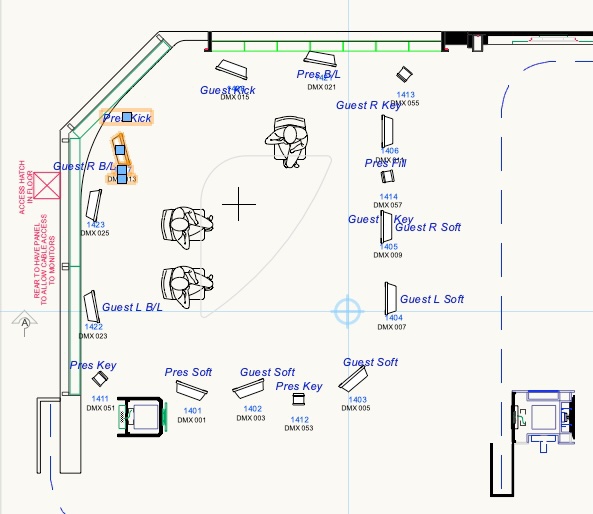
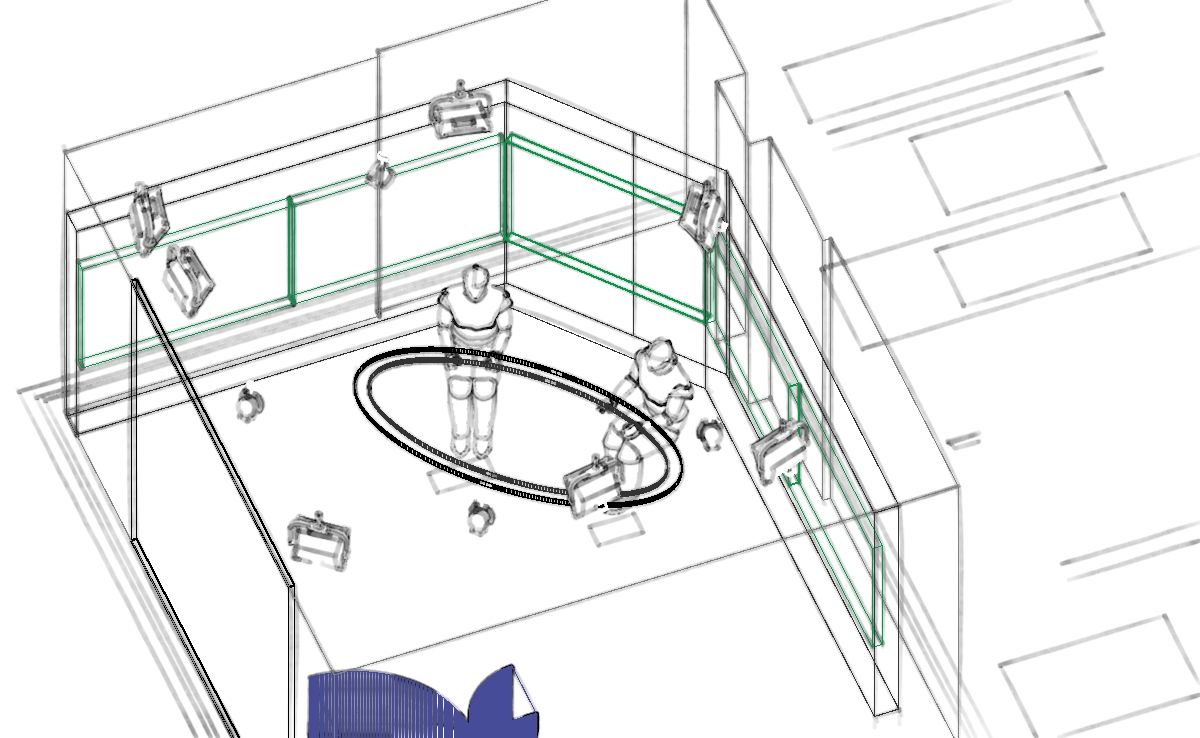
Located very unusually in the corner of CNBC’s London Studio, these were a pair of small studio spaces, staffed by just a single presenter and a technical supervisor, with guests able to quickly come and go from their near-by offices in the Square Mile. The move into a shared operational space was triggered by a combination of Sky News needing to move out of their previous studio space in the Gerkin, and the then-recent takeover of Sky by Comcast, who were looking to save money across the combined business by reducing sites. together with a hasty change of their US News Network partnership - previously Fox, with whom were now no longer Friends…
To keep in-line with the previous Tardis project’s naming schemes being both logical, inconsistent, and confusing, these were called City 2 and City 3 (City 1 being reserved for CNBC’s studio which they didn’t call it, and City 3 was actually a sub-set of City 1)
City 2
Example of City Studio 2 in use
City 3
Millbank Main - Multi-use space
- Millbank various relights including major Refurb 2020 (during Pandemic - had to install mostly single-handedly)
Sky Sports Racing
MUCH MORE TO COME
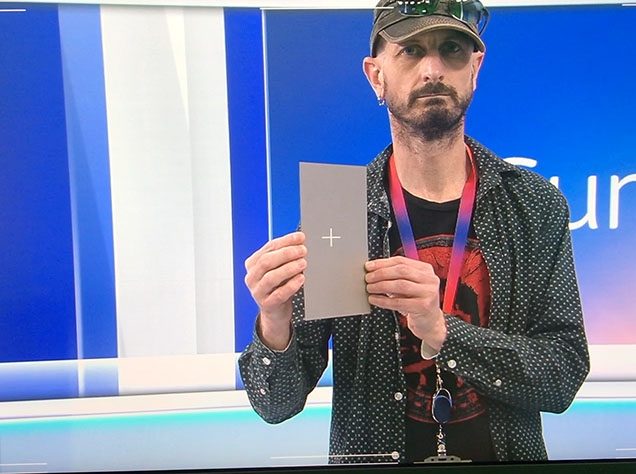
Sky Sports News
Overall Supervisory & Support 2018-2023
Completely replaced the original and worn-out 1st generation LED Lights with new fixtures in 2018 in a rolling series of overnight changes performed in a narrow window (4-5 hours), repatching, reprogramming, and rebalancing the each new block of lights night after night - all without disrupting daily output.
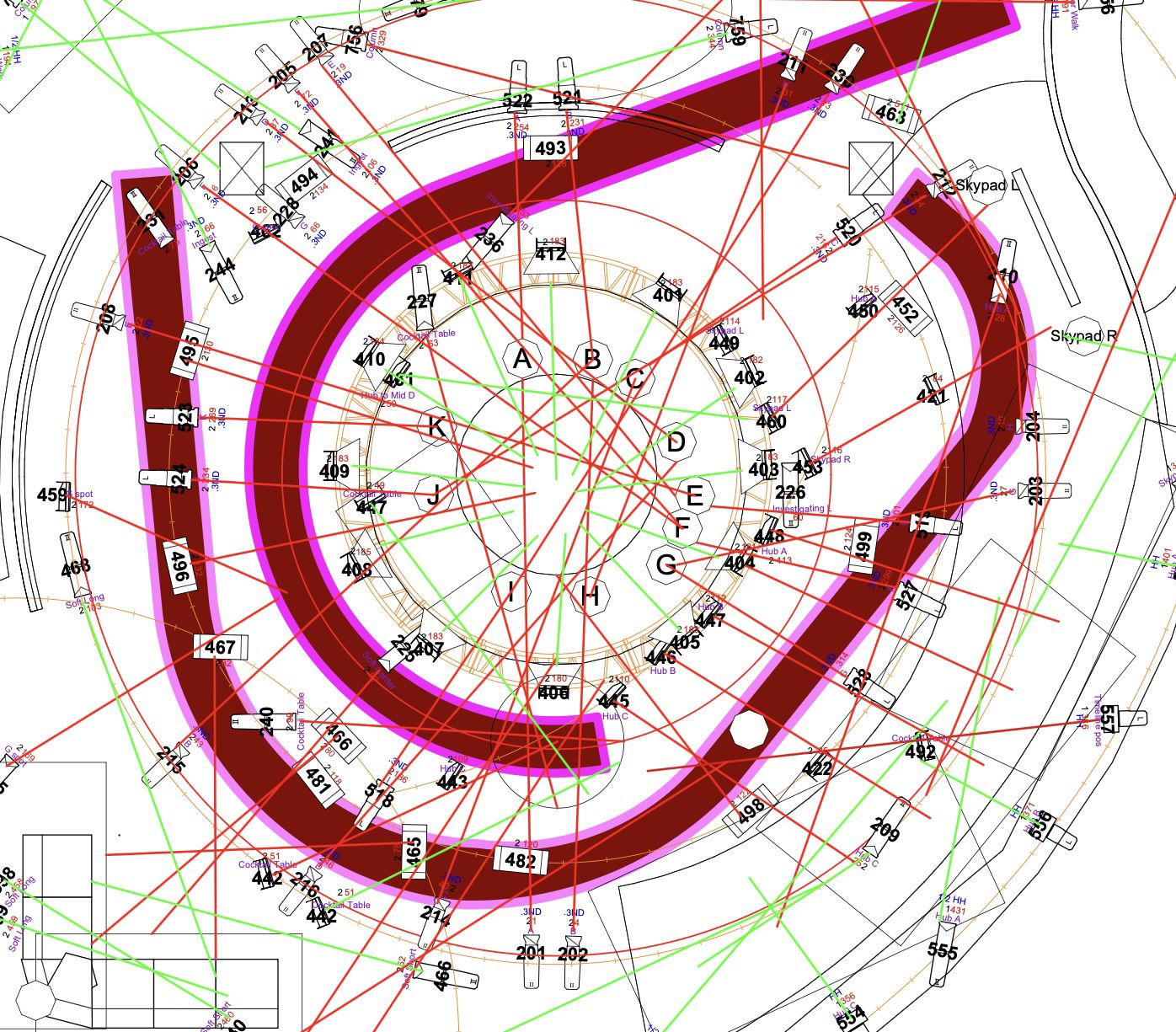
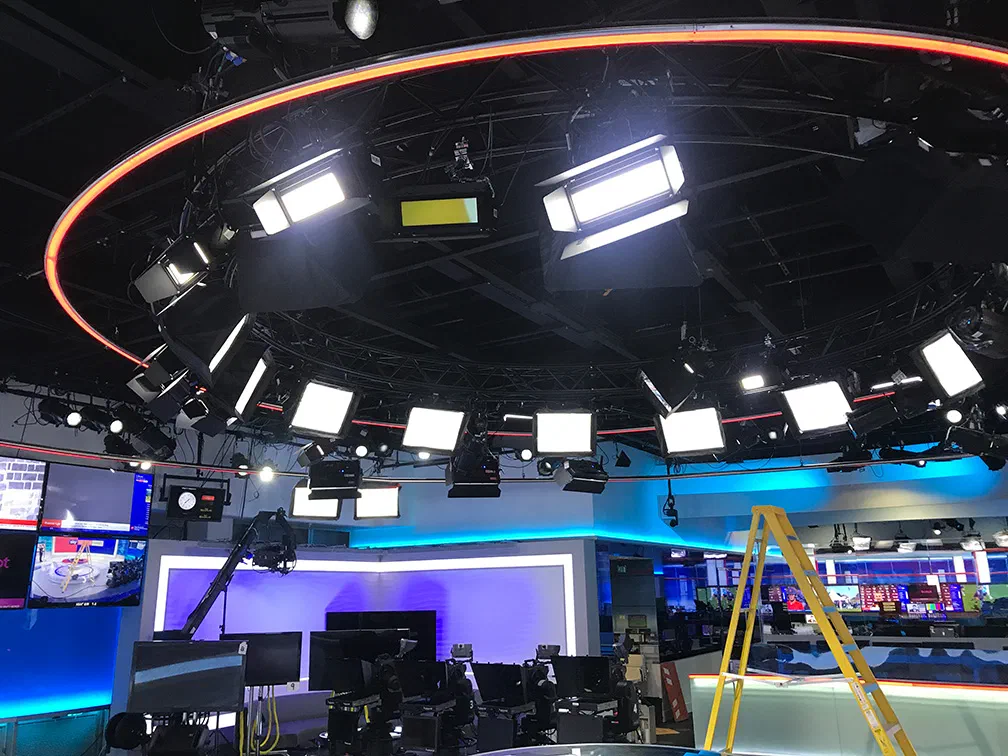
In 2020, during the height of Covid lockdown and with very little other than a single presenter talking to camera, who was easily moved to anther studio, and all the journalists, editors, and so on working remotely, it was possible to have the first significant rebuild of the main area of the newsroom/studio since it opened 9 year earlier. However, apart from a couple of new lightboxes, this wasn’t about set changes, but putting in flown camera tracks (instead of the manually-operated jib) and replacing the floor robots with new units;..
Two ceiling-mounted camera tracks, similar to the ones used in the glass box, were installed to replace the work previously done by a Jib (although not as flexible of course). The lighting was repositioned to take this into account, and new presentation positions at the main desk were created.
Additional lights were added, giving a new outer 360-degree ring of Arri S60’s with 8-cell Eggcrates, allow impromptu Presentation or Guests anywhere in the central area, shot from any direction, for the first time. As at the earlier Millbank refurbishment, Richard had to do the bulk of the work rigging and cabling all the equipment himself due to heavy restrictions on personnel movements between different areas.
Lighting control also shifted from a dedicated Multi-Skilled Operator to the Camera MSO, which was a necessity by this point as none of the remaining MSO team were lighting specialists. A touchscreen system was developed based on feedback from the MSO’s, designed to give a rapid recall of a standard base with the ability to tweak as needed. Despite initial request for multiple fader wings, it was notable that these, along with the main Gio console, were generally depreciated in favour of the touch-screen controls.
MORE TO COME
Sky Studios Cafe
A Fixed installation of trussing and lights in a public space (in-house coffee shop), originally intended for use for just one hour a week and so very lightly provisioned; this rapidly ended-up being used by up to 3 different productions a day…until the novelty wore-off after a year, whereupon the space was then only used as studio a bare handful of times ever again!
–> FIND PICTURES <–
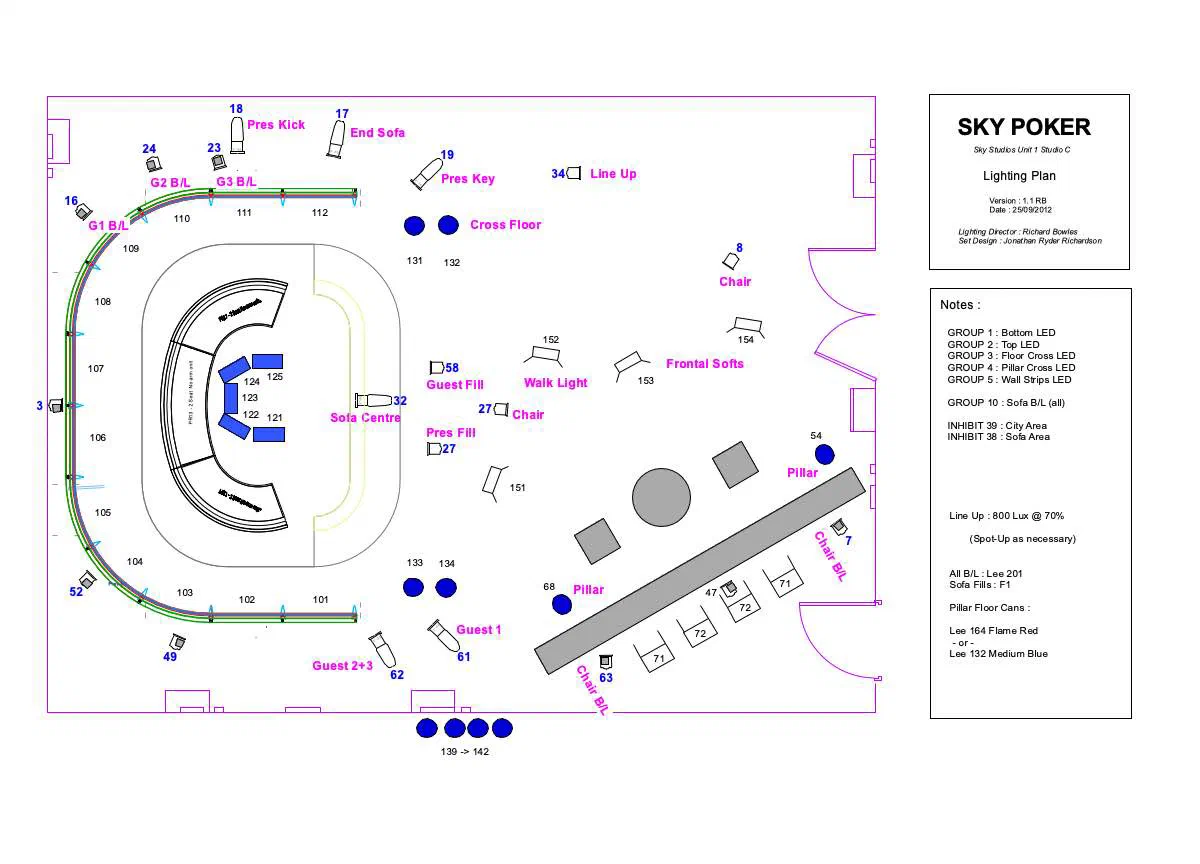
Sky Poker
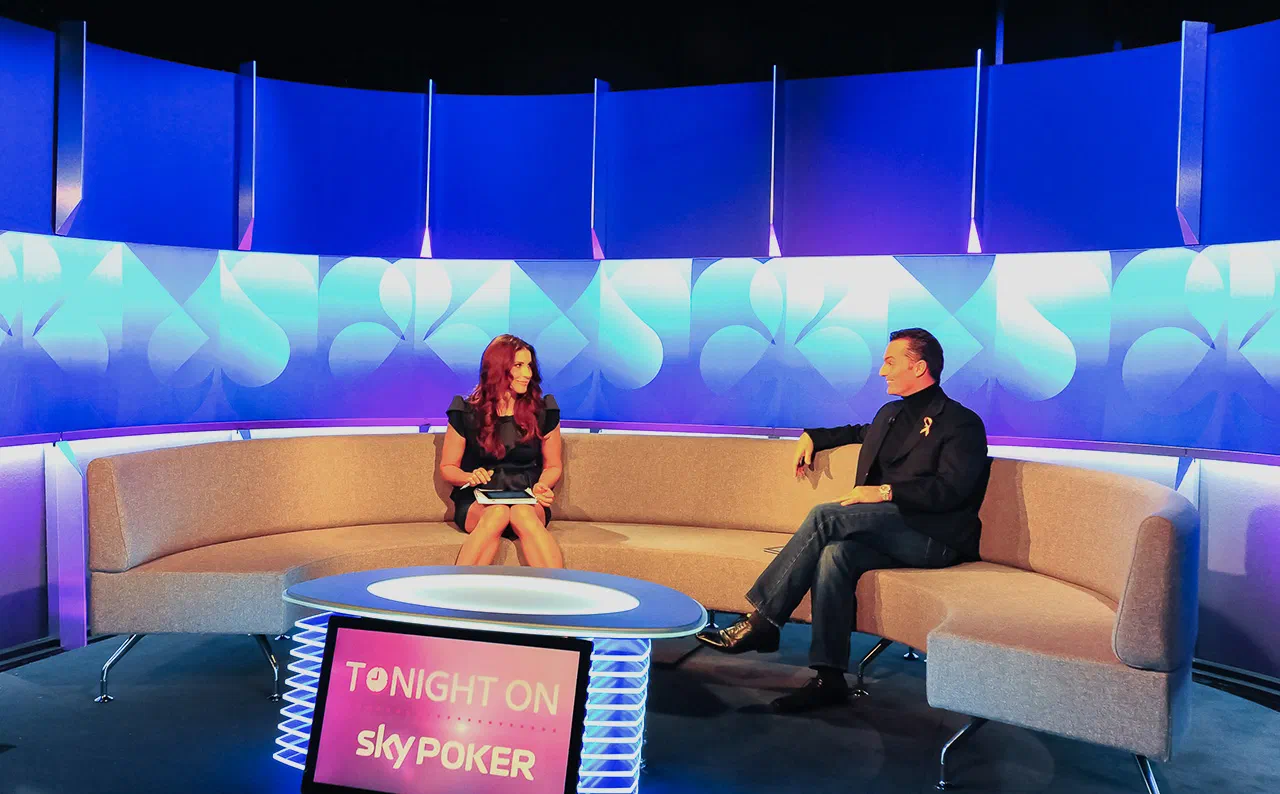
Conversion of old Studio C (previously the Channel 5 News Studio) into a fixed studio. Used for a few years before they moved up north. Was, at the time this opened, the only studio had that was still operating in SD (Standard Definition). Years later, this studio became the lighting workshop.
Along with the scavenged-together antique cameras, equally antique lights were found for this, with a mixture of Strand SL Profiles, 1k Pups, Arturo softlights, and a well-used set of Pulsar chromabricks (which were last seen still chugging-away in the SSR set, not bad for 20 year old 1st generation LED’s…)
The General-Purpose Studios (Sports, Entertainment, etc)
When Richard first arrived, he found there was a multitude of different and incompatible lighting control systems in use, with the majority of control being done with manual faders (regardless of how basic or advanced the controller was) - giving little consistency from week to week. Each studio had its own unique technical infrastructure and challenges, and although there were a number of moving lights and considerable numbers of early led effects units, these were little understood at that time by the in-house electricians.
Within just a couple of years, continuing the work of his predecessor Don Hart, he succeeded in drastically simplifying and unifying the control consoles into a single family (ETC Eos) - ultimately purchasing over 30 assorted versions all the way from a simple Nomad to the Apex. This was enhanced by standardising the channel and cue structures across site, hugely helping the Electrician’s who often had to operate completely unfamiliar productions. The control infrastructure behind the scenes also migrated towards the Sky Studios structure as much as possible, and all new builds were built in that format.
Over time, all the lighting electricians were successfully encouraged to embrace the benefits - and reduced work load, of consistent, quick, and repeatable, Cue-based operation. More importantly, the general standards of lighting faces improved, with far less excess Fill light; something critical as the studio cameras used during this time quickly moved through the alphabet soup from SD to HD, side-tracked briefly into 3D, and then increased in resolution and colour-space once again to UHD. During this 10 years of rapid technology change, many of the lights used were 20 years old at the start, and 30 years old at the end - yet still perfectly suitable when used appropriately, if no longer politically acceptable due to their carbon footprint.